Request Handling
http://helenaedelson.com/?p=879
This
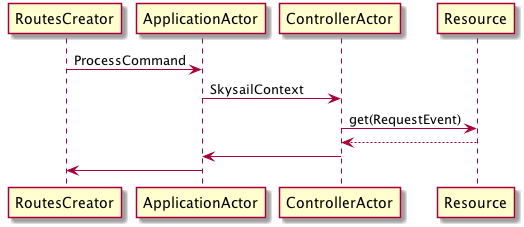
RoutesCreator (Actor):
Matches the request to a Handler via the requests URI, applying a series of common Directives (to deal with authentication, content negotiation etc). If no route is created matching a specific URI, skysail will return the usual 404 response.
Otherwise, if a match is found, a new ProcessComand message is sent to the associated application actor:
val applicationActor = ... // get the application actor for the current Application
val processCommand = ProcessCommand(requestContext, resourceClass, urlParameter, unmatchedPath)
(applicationActor ? processCommand).mapTo[ListResponseEvent[_]]
...
The ProcessCommand is created using
- the current akka.http.scaladsl.server.RequestContext
- the resource class (extending io.skysail.core.resources.Resource), which defines the business logic to be executed for this request
- to be done
- the "unmatched path", which is the optional suffix of the URI which was not matched completely.
ApplicationActor
The ApplicationActor handles the ProcessCommand created by the RoutesCreator:
case cmd: ProcessCommand => {
  ...
  val theClass = cmd.resourceClass.newInstance()
  val controllerActor = ... // create new ControllerActor as Child
  (controllerActor ? SkysailContext(cmd, appModel, theClass, bundleContext)).mapTo[ListResponseEvent[_]]
  ...
}
It uses the resource class from the ProcessCommand to create a new instance of this class (which will be used to actually execute the business logic associated with the request).
There is only one ApplicationActor per Application, but each request creates a new ControllerActor as a child actor to the application actor.
A new SkysailContext object is sent to the newly created ControllerActor using
- the original ProcessCommand
- the applicationModel of the current Application
- the new resource instance and
- the OSGi bundle context.
ControllerActor
Now its the newly created ControllerActors responsibility to match the request method and call the appropriate method on the resource class:
cmd.ctx.request.method match {
  case HttpMethods.GET => resource.get(RequestEvent(cmd, self))
  case HttpMethods.PUT =>
  case HttpMethods.DELETE =>
  case HttpMethods.POST => resource.asInstanceOf[PostSupport].post(RequestEvent(cmd, self))
  case e: Any => resource.get(RequestEvent(cmd, self))
}
Resource
A Resource instance is not an actor. It is called by a ControllerActor to execute the business logic for this request and will send back a ResponseEvent to its original ControllerActor:
def get(requestEvent: RequestEvent): Unit = {
    val r = ... // async business logic
    r onComplete {
      case Success(success) => requestEvent.controllerActor ! ListResponseEvent(requestEvent, apply(success))
      case Failure(failure) => ...
    }
  }
}
Now the execution returns back in the actor chain, as the original ControllerActor is sent back a ResponseEvent or ListResponseEvent:
ControllerActor
Depending on the request's Accept-Header, the MediaTypeNegotiator is used to determine how to actually render the retrieved Response:
case response: ListResponseEvent[T] =>
  val negotiator = new MediaTypeNegotiator(response.req.cmd.ctx.request.headers)
  val acceptedMediaRanges = negotiator.acceptedMediaRanges
  ...
  val m = Marshal(response.resource.asInstanceOf[List[_]]).to[RequestEntity]

  if (negotiator.isAccepted(MediaTypes.`text/html`)) {
    handleHtmlWithFallback(response, m)
  } else if (negotiator.isAccepted(MediaTypes.`application/json`)) {
    handleJson(m, response)
  }
case response: ResponseEvent[T] =>
  ... // similar to ListResponseEvent
Somewhere in handleXXX:

val answer = HttpEntity(ContentTypes.`text/html(UTF-8)`, <body>)
applicationActor ! response.copy(resource = response.resource, httpResponse = response.httpResponse.copy(entity = answer))
So, the ResponseEvent is sent back up in the chain to the ApplicationActor:
ApplicationActor
val r = ... // the async result from calling the controller actor
r onComplete {
  case Success(value) => routesCreator ! value
  case Failure(failure) => ...
}
Finally, the RoutesCreator gets the response:
RoutesCreator
val t = ... // the async result from calling the application actor
onComplete(t) {
  case Success(result) => complete(result.httpResponse)
  case Failure(failure) => ...; complete(StatusCodes.BadRequest, failure)
}